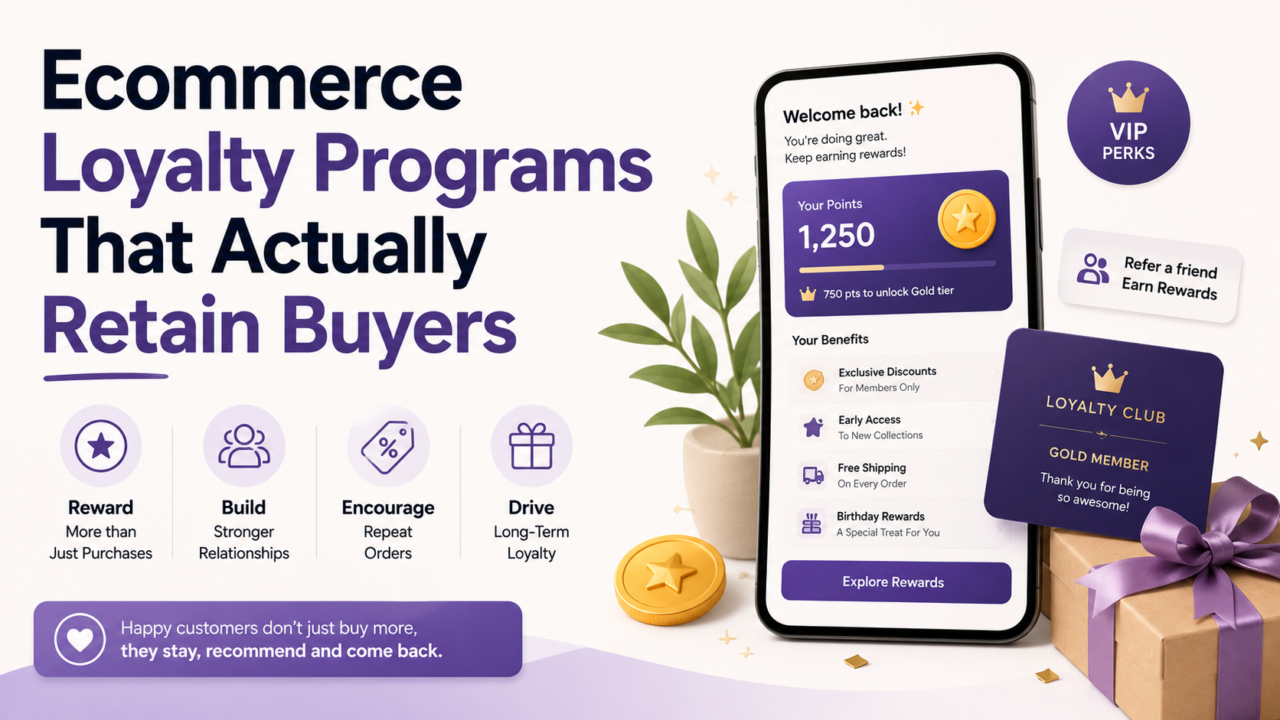
Most ecommerce loyalty programs do not create loyal buyers. They hand discounts to people who were going to buy again anyway.
That is the part almost nobody says out loud. You install a points app, 8,000 people sign up, the dashboard turns green, and you call it a win. Meanwhile your repeat rate has not moved. You just gave away margin to your best customers and added a liability to your balance sheet.
Here is the thing most guides skip: an ecommerce loyalty program is not a marketing campaign. It is a debt. Under US accounting rules, unredeemed points are money you owe customers, and you have to carry them on your books.
Run it like a ledger and it prints profit. Run it like a feature you installed once, and it quietly bleeds you.
This guide covers the program types, real DTC examples, the full USD cost math, the accounting nobody warns you about, and the one test that proves whether any of it worked.
Quick Answer
What is an ecommerce loyalty program? A structured system that rewards customers for repeat purchases and other actions, usually through points, tiers, paid membership, or a mix.
Does a loyalty program increase retention? Sometimes. Enrollment numbers prove nothing. You need a holdout group to see whether the program caused anything.
Points or tiers? Points fit brands where people buy every 30 to 60 days. Tiers fit brands where people buy a few times a year and care about status.
How many points per dollar? Set effective return at 1 to 5 percent. A common setup is 1 point per $1 with 100 points worth $5.
What does it cost? Budget 4 to 6 percent of member revenue in reward value, plus software and staff hours. Setup ranges from roughly $100 to $40,000 depending on complexity, according to LoyaltyLion.
What is a good loyalty program ROI? Antavo’s 2025 industry survey found 83 percent of brands with programs reported positive ROI. In our worked example below, a store needs just 0.12 extra orders per member per year to break even.
The catch nobody mentions: Under ASC 606, loyalty points are a “material right.” You must defer part of the sale revenue until points are redeemed or expire.
Why Do Most Loyalty Programs Fail To Retain Buyers?
They fail for one reason. Nobody checks whether the program caused anything.
Here is the trap. You pull a report. Loyalty members buy 3.2 times a year. Non members buy 1.4 times a year. The vendor calls this proof.
It is not proof. It is backwards.
People who already love your brand are the ones who join loyalty programs. The program did not make them loyal. Their loyalty made them join.
This is selection bias, and it is baked into nearly every loyalty stat online. A Growave study of over 100 Shopify brands found that members who redeem rewards make 2.5 times as many repeat purchases as non redeemers, with 23 percent higher average order value. Those are real numbers from real stores. But they compare redeemers to non redeemers. Active buyers redeem. Inactive buyers do not. The gap partly measures who was already engaged.
Use those numbers as a signal to drive redemption. Do not use them as proof your program works. Only a holdout test does that.
Other common failure points:
- The reward is too small to notice. Earning 40 cents on an $80 order changes nobody’s behavior.
- The reward is too big to survive. A 10 percent earn rate on a 45 percent margin product eats a fifth of your gross profit.
- Nobody redeems. Points pile up, customers forget, and the program becomes invisible.
- No owner. Someone installed the app in March. It is July and nobody has touched the settings.
- It rewards the wrong action. Paying people for a purchase they already planned is not growth.
- It hides a broken experience. Late delivery, wrong sizing, slow support. No amount of points fixes that.
Retention is an operations problem before it is a rewards problem. We break that down in our guide on ecommerce customer support KPIs that predict retention.
What Types Of Ecommerce Loyalty Programs Actually Work?
Six structures exist. Four are worth your time as a DTC brand. Pick based on how often people buy, not on what looks impressive in a demo.
1. Points Programs
Customers earn points per dollar spent. Points convert to store credit or discounts.
- Best for: Purchases every 30 to 60 days. Supplements, coffee, skincare, pet food, consumables.
- Why it works: People watch a balance grow. Visible progress pulls them back.
- Where it breaks: Slow purchase cycles. If someone buys twice a year, points feel pointless.
- Typical earn rate: 3 to 5 percent of spend in reward value.
2. Tiered Programs
Customers move up levels based on spend. Higher tiers unlock better perks.
- Best for: Fewer, larger orders. Apparel, home goods, jewelry, premium gear.
- Why it works: Status is sticky. Once someone hits Gold, dropping back feels like a loss. Loss aversion drives more purchases than any discount. Antavo’s research suggests tiered programs return about 1.8 times what flat programs do.
- Where it breaks: Small member bases. If 90 percent sit in the bottom tier, there is no ladder.
- Watch for: Annual resets create urgency. Lifetime tiers create dead weight.
3. Paid Memberships
Customers pay a fee for perks like free shipping, member pricing, or early access.
- Best for: High frequency buyers where savings clearly beat the fee.
- Why it works: The fee filters for committed buyers and creates a sunk cost that pushes more purchases.
- Where it breaks: Low order frequency. If the math fails for the customer, they cancel and feel cheated.
- Bonus: The fee is revenue on day one, not a cost. It arrives before the customer buys anything, which is the same cash flow logic behind subscription ecommerce and recurring revenue.
4. Hybrid Programs
Points as the base, tiers on top, referrals bolted on.
- Best for: Brands past $3M in revenue with a real member base.
- Why it works: Points reward every purchase. Tiers reward big spenders. Referrals bring new buyers.
- Where it breaks: Complexity. If a customer cannot explain your program in one sentence, they will not use it.
5. Value Based Programs
You donate a share of profit to a cause instead of rewarding the customer directly.
- Best for: Mission led brands where buyers already care about the cause.
- Reality check: This builds brand affinity, not repeat purchase behavior. Treat it as a brand play, not a retention lever. Do not expect it to move your repeat rate on its own.
6. Coalition Programs
Customers earn and redeem across multiple non competing brands.
- Best for: Almost nobody under $50M. It requires partner contracts, shared liability accounting, and legal work.
- Skip it unless you have a partnerships team.
Rule of thumb: Start simple. Add layers when your data says to, not when a vendor demo says to.
Points Vs Tiered Loyalty Program: Which Should You Pick?
| Factor | Points Program | Tiered Program |
|---|---|---|
| Purchase frequency | Every 30 to 60 days | Every 90 to 180 days |
| Average order value | Under $60 | Over $80 |
| Psychological driver | Progress toward a reward | Status and fear of losing it |
| Setup effort | Low | Medium |
| Ongoing ops load | Low | Higher, tiers need monitoring |
| Cost predictability | High, earn rate is fixed | Lower, top tier perks vary |
| Members needed to work | Any size | 2,000+ active members |
| Main risk | Feels transactional | Bottom tier feels ignored |
Short version: If people buy monthly, use points. If people buy a few times a year and care about being treated well, use tiers.
The one number that decides it: Pull the average number of days between order one and order two. Under 60 days, points win. Over 90 days, tiers win. Between the two, run points first and layer tiers on later.
What Are Real DTC Rewards Program Examples Worth Copying?
Look at structure, not branding. Here is what these programs actually do and what to take from each.
Sephora Beauty Insider (tiered, three levels) Widely treated as the benchmark. Points on spend, plus tier perks and periodic point multiplier events that concentrate spending into short windows. Steal this: The multiplier event. It pulls forward purchases you were going to get later, which improves cash flow without a permanent discount.
Gymshark (points, engagement based) Members earn XP for shopping, opting into email and SMS, and completing workouts in the brand’s training app. Steal this: Rewarding non purchase actions. Every action gives you first party data and another reason to contact them.
100% Pure Purist Perks (tiered, annual spend) Three tiers set at $0, $250, and $750 of spend per calendar year. Top tier gets early access, free expedited shipping, and priority support. Steal this: The threshold math. Entry tier is reachable in two orders. Top tier sits near their high spender band. Both feel earned.
Tomlinson’s Pet Club (paid membership) $10 per year for 10 percent off pet food plus member only offers. Steal this: The tiny fee. It is small enough to be an easy yes and large enough to filter for committed buyers. Perfect for consumables.
Nordstrom Nordy Club (tiered, high thresholds) Members must hit $500 per year for Influencer status or $5,000 for Ambassador. Steal this: Publishing the thresholds. Customers who can see the number will spend toward it.
Amazon Prime (paid membership at scale) Over 200 million paid members globally. The fee is recurring, high margin revenue that arrives before any order. Steal this: The principle, not the program. Paid membership works when the perk is used often enough to obviously beat the fee.
What none of these tell you: Their margins are not your margins. Copying Sephora’s generosity on a 38 percent margin product will bankrupt the program. Copy the mechanic, then price it against your own gross margin.
How Many Points Per Dollar Should You Give?
This is the question every guide dodges. Here is a straight answer.
Forget the points number. It is cosmetic. The only figure that matters is your effective return: how many cents a customer gets back per dollar spent.
Most successful programs land between 1 and 5 percent.
| Effective return | Example setup | Cost as share of gross profit at 55% margin | Verdict |
|---|---|---|---|
| 1% | 1 point per $1, 100 points = $1 off | 1.8% | Too small to change behavior |
| 3% | 1 point per $1, 100 points = $3 off | 5.5% | Safe starting point |
| 5% | 1 point per $1, 100 points = $5 off | 9.1% | Most common, watch it closely |
| 8% | 1 point per $1, 100 points = $8 off | 14.5% | Only if margin is above 65% |
| 10% | 1 point per $1, 100 points = $10 off | 18.2% | Almost always a mistake |
How to read that third column. Divide your earn rate by your gross margin. A 5 percent earn rate on a 55 percent margin costs 9.1 percent of your gross profit. That is the number to take to your finance conversation, not the 5 percent. If you are unclear on your true margin per order, start with our guide to contribution margin for ecommerce.
The bigger numbers trick
A 5 percent return can be written two ways:
- 1 point per $1, and 100 points gets $5 off
- 10 points per $1, and 1,000 points gets $5 off
Identical cost. But the second one makes a customer’s balance read “1,240 points” instead of “124 points.” Bigger numbers feel like more progress. Use the inflated ratio. It costs nothing.
Make the first reward reachable in two orders
This is the most common design mistake. Brands set the first reward so far out that customers give up before they get near it.
There is real research behind this. In a study published in the Journal of Consumer Research, Joseph Nunes and Xavier Drèze gave 300 car wash customers one of two loyalty cards. One needed 8 stamps starting from zero. The other needed 10 stamps but arrived with 2 already filled in.
Both required exactly 8 purchases. The economics were identical.
Over nine months, 19 percent of the blank card group finished. 34 percent of the pre stamped group finished. Nearly double, for the same real effort. Wharton’s summary of the research calls this the endowed progress effect.
Two things to steal from it:
- Give a signup bonus. 100 or 200 points on account creation. It costs little and moves people off zero, which is the hardest place to leave.
- Show a progress bar. “You are 60 points from your next reward” beats “You have 140 points.”
Set your first reward just above what someone can earn from non purchase actions alone. Otherwise people collect the freebies and never buy.
What Is The LEDGER Framework For Building A Loyalty Program?
A loyalty program is a promise you record now and pay later. So treat it like a ledger. Six decisions, in order.
L: Limit
Cap your exposure before you write a single rule.
- Set a maximum reward value as a percent of member revenue. Four to six percent is a sane band.
- Exclude discounted orders from earning points. Otherwise you stack discount on discount.
- Exclude gift cards, taxes, and shipping fees from the earn calculation.
- Cap points earned per order so one bulk buyer cannot drain the pool.
E: Earn
Set the earn rate and the actions that trigger it.
- Anchor on gross margin, not revenue. A 5 percent earn rate on a 40 percent margin product costs 12.5 percent of your profit.
- Reward more than purchases: referrals, birthdays, account creation, SMS opt in, and reviews. Points are one of the cleanest ways to ask for reviews after purchase without feeling pushy.
- Weight the second purchase heavily. Order two is the hardest one to get. More on that in how to turn first time buyers into repeat customers.
- Use multipliers to steer behavior: double points on slow moving inventory, double points on a reorder inside 30 days.
D: Deadline
Points that never expire become a growing liability with no upside.
- Expire points after 12 months of account inactivity, not 12 months from the earn date.
- Email a warning 30 days out and 7 days out. These are usually the highest converting emails in the entire program, so build them into your ecommerce email marketing flows rather than sending them manually.
- State expiry clearly in your terms. Vague reward promises create disputes and chargebacks, and the FTC expects advertising claims to be substantiated and clear.
- Check your state law first. See the accounting section below. Expiry is not always legal.
G: Gate
Build the status layer, if tiers fit your model.
- Three tiers maximum. Four confuses people.
- Set the entry threshold near your current two order customer value. Make it reachable.
- Set the top tier near the 90th percentile of customer spend. Make it earned. Pulling those percentiles cleanly depends on your CRM data being in order.
- Give perks that cost little but feel large: early access, free shipping, a real human support line, first pick on restocks.
E: Evidence
The step nearly everyone skips, and the only one that proves the program works.
- Hold back 10 percent of eligible customers. Do not enroll them. Do not email them about it.
- Run 90 days minimum, 180 days if your purchase cycle is slow.
- Compare orders per customer, revenue per customer, and gross profit per customer across the two groups.
- That difference is your real lift. Everything else is a vanity metric.
This is not a nice to have. This is not optional. Accounting guidance on loyalty programs calls for control group data to prove the program caused the lift. Your auditor may ask to see it.
R: Run
A loyalty program is a weekly job, not an install.
- Weekly: Enrollment rate, redemption rate, points liability balance.
- Monthly: Tier distribution, reward cost as a percent of member revenue.
- Quarterly: Rerun the holdout comparison. Update your breakage estimate. Adjust earn rates.
- Always: One named person owns the number. Not the founder. Not the app vendor. Write it up as a repeatable process using our approach to ecommerce SOPs for remote teams.
That last point is where most brands stall. The program is not hard. It is just constant. Somebody has to look at it weekly, adjust offers, clean segments, and write the emails. This is exactly the recurring execution a dedicated customer support and retention team should own end to end.
What Does A Loyalty Program Actually Cost? A Worked Example
Here is the math nobody shows you. All figures in USD.
The store:
- Annual revenue: $2,400,000
- Average order value: $80
- Orders per year: 30,000
- Gross margin: 55 percent
- Loyalty members: 8,000
- Member share of revenue: 40 percent, so $960,000
Program design:
- Earn rate: 5 percent of spend in reward value
- Breakage (points issued but never redeemed): 35 percent
Annual costs:
| Cost line | Calculation | Amount |
|---|---|---|
| Reward value issued | $960,000 x 5% | $48,000 |
| Less breakage | $48,000 x 35% | ($16,800) |
| Reward value actually redeemed | $31,200 | |
| Loyalty software | $299 x 12 | $3,588 |
| Ops time | 6 hrs/week x $22/hr x 52 | $6,864 |
| Total annual cost | $41,652 |
That $22 per hour assumes offshore support staffing. Run the same six hours through a US hire and the ops line roughly triples, which is often what flips a program negative. We break the comparison down in US labor costs for ecommerce and D2C brands.
Redeemed rewards cost you the full dollar amount. A $5 discount is $5 off your price, and price cuts come straight out of gross profit.
Now the return. This is where the holdout test earns its keep.
Say your 90 day test shows members averaged 1.9 orders per year and the holdout averaged 1.6.
- Incremental orders per member: 0.3
- Total incremental orders: 8,000 x 0.3 = 2,400
- Incremental revenue: 2,400 x $80 = $192,000
- Incremental gross profit: $192,000 x 55% = $105,600
- Net gain: $105,600 minus $41,652 = $63,948
- ROI: 154 percent
Strong program. Keep it.
Now run it with a weak lift.
Say the real difference is only 0.08 orders per member.
- Incremental orders: 640
- Incremental revenue: $51,200
- Incremental gross profit: $28,160
- Net result: $28,160 minus $41,652 = negative $13,492
The dashboard still shows 8,000 happy members. The P&L shows a loss.
Your break even number:
To cover $41,652 at 55 percent margin, you need $75,731 in incremental revenue. That is 947 extra orders across 8,000 members.
That is 0.12 extra orders per member per year.
Write that number on a wall. It is the single figure that decides whether your loyalty program is an asset or a leak. It also belongs next to your cost per order, since both move together.
Why Not Just Give Everyone A Flat Discount?
Fair question, and the honest answer is that sometimes you should.
In the example above, $31,200 of redeemed rewards on $960,000 of member revenue is a 3.25 percent effective discount. You could hand every customer 3.25 percent off and spend the same money.
So why bother with the machinery?
Because of who spends it.
- A flat discount comes off every order, including from people who buy once and vanish.
- A loyalty reward is only redeemed by someone who comes back.
Same headline cost. Loyalty concentrates every dollar on a repeat purchase, then adds breakage on top, so you keep 25 to 45 percent of what you issued.
When a flat discount actually wins:
- You are under 1,000 repeat customers, so there is nothing to concentrate.
- Your margin is thin enough that the software and staff cost outweighs the targeting benefit.
- Your buyers are price led rather than brand led, and simplicity converts better.
When loyalty wins:
- You have a real repeat base and want to spend only on people who return.
- You want first party data, which a discount code gives you nothing of.
- You want to steer behavior, not just cut price.
If you are still deciding how to use discounting at all, our breakdown of pricing strategies for ecommerce growth covers the tradeoffs.
How Do Loyalty Points Affect Your Accounting And Taxes?
This is the section your loyalty app vendor will never show you. It matters most when you raise money or sell the business.
Points are a liability, not a marketing expense
ASC 606 is the US revenue recognition standard. Under it, loyalty points usually count as a material right. That means the customer got an option to buy later at a price nobody else gets.
In plain terms:
- Points are a separate promise inside the sale.
- You must set aside part of that sale’s revenue.
- You only recognize it when points are redeemed or expire.
So a $100 order with points attached is not $100 of revenue today. A small slice gets deferred.
At one order this is noise. Across 30,000 orders a year, it becomes a real number on your balance sheet.
Breakage is income, but you cannot grab it all at once
Breakage is the share of points customers never redeem. It is usually 25 to 45 percent.
The rules are specific here. You recognize breakage income gradually, in proportion to actual redemptions. You cannot book it the day you issue the points, and you cannot wait and dump it all in one quarter.
Practical effect: you need a breakage estimate based on your own redemption history, updated at least quarterly.
The trap almost nobody mentions
Some states treat unredeemed customer balances as unclaimed property. If your program is structured so the reward looks like stored value rather than a discount, you may owe that balance to the state instead of keeping it.
Under ASC 606, if you are required to hand unredeemed amounts to a government body, that money never becomes your revenue. It stays a liability forever.
What to do:
- Structure rewards as percentage discounts, not fixed dollar store credit, where you can.
- Never let a loyalty balance be transferable or cashable.
- Check your state rules through the National Association of Unclaimed Property Administrators.
- Ask your accountant before you set expiry rules, not after.
Bottom line: Before you launch, spend 30 minutes with your accountant on three questions. How do we book issued points? What breakage rate do we use? Does our reward structure trigger unclaimed property rules in our state?
None of your competitors’ guides will tell you this. Your auditor will.
Which Metrics Prove A Loyalty Program Is Working?
Ignore enrollment count. Ignore points issued. Both go up even when the program does nothing.
Track these seven instead:
- Incremental orders per member. Member group minus holdout group. The only metric that proves causation.
- Redemption rate. Points redeemed divided by points issued. Under 20 percent means rewards are not compelling. Over 70 percent means you are too generous.
- Reward cost as a percent of member revenue. Keep it under 6 percent unless margins are unusually fat.
- Points liability balance. Total unredeemed point value on your books. This grows quietly and shows up all at once.
- Breakage rate. Needed for your accounting, and it tells you if rewards are too hard to reach.
- Tier movement rate. What percent climbed a tier this quarter? Under 5 percent means thresholds are too high.
- Member gross profit per customer. Not revenue. Profit, after rewards.
Pair these with your post purchase flows. Rewards give people a reason to come back. A post purchase cross sell system and a solid upsell and cross sell playbook decide what they buy when they do.
When Should You NOT Launch A Loyalty Program?
Skip it, or delay it, if any of these are true:
- Your repeat rate is under 10 percent. Fix product, shipping, or support first. Rewards cannot cover a broken experience. Start with a customer service management system built for retention.
- Your gross margin is under 35 percent. There is not enough room to give value away.
- You sell one time purchases. Mattresses, furniture, wedding items. A referral program beats a points ledger.
- You have fewer than 1,000 repeat customers. The sample is too small to test anything. Money spent to reduce your abandoned cart rate will return more at this stage.
- Nobody can own it weekly. An unmanaged program is worse than no program. It creates liability and expectation with no return.
- You cannot answer the accounting questions above. Launching without a breakage policy means restating numbers later.
Honest take: for a lot of brands under $1M, a strong post purchase email sequence and faster support replies will beat a loyalty app. Loyalty programs reward a base you already have. They do not build one.
How Do You Launch A Loyalty Program In 30 Days?
Week 1: Pull the numbers
- Repeat purchase rate, days between order one and order two, AOV by order number, gross margin by category.
- Pick points or tiers using the frequency test above.
Week 2: Design, cap, and check the law
- Set earn rate, exclusions, expiry rules, and tier thresholds using LEDGER.
- Model the cost. Calculate your break even orders per member. Get sign off on that number.
- Run the reward structure past your accountant for ASC 606 and unclaimed property.
Week 3: Build and hold back
- Configure the platform. Tag your 10 percent holdout group and exclude them from every loyalty email.
- Write the four core emails: welcome, points balance, near tier, expiry warning.
Week 4: Launch narrow
- Launch to past customers only. Not to new traffic yet.
- Add the enrollment prompt to the order confirmation page and a packing slip insert.
- Set the weekly review. Fifteen minutes, one owner, three metrics.
Then wait 90 days before you judge anything.
Key Takeaways
- Enrollment numbers are not results. A holdout group is the only honest test of retention lift.
- Points suit buyers who purchase every 30 to 60 days. Tiers suit higher value, less frequent buyers.
- Budget 4 to 6 percent of member revenue in rewards, plus software and staff hours.
- Redeemed rewards cost full price. They come straight out of gross profit.
- Most brands need roughly 0.1 to 0.15 extra orders per member per year to break even.
- Under ASC 606, points are a deferred liability, not a marketing expense. Set a breakage policy before launch.
- Some states may claim your unredeemed balances as unclaimed property. Check before setting expiry rules.
- Set effective return between 1 and 5 percent. Divide earn rate by gross margin to see the true cost.
- Give a signup bonus and show a progress bar. Nunes and Drèze found pre filled progress nearly doubled completion rates.
- Copy the mechanics from Sephora, Gymshark, or 100% Pure. Do not copy their generosity without checking your margin.
- A program without a weekly owner becomes a liability, not an asset.
FAQs
Does a loyalty program increase retention?
It can, but only when it changes behavior you can measure. Hold back 10 percent of customers from the program, run it for 90 days, then compare orders per customer between the two groups. That difference is your real retention lift. Reports that compare members to non members without a holdout are misleading. Loyal customers self select into these programs.
What are the best loyalty programs for Shopify stores?
Structure matters more than the app. Choose points if customers buy every 30 to 60 days, tiers if they buy every 90 to 180 days, and a paid membership if they buy monthly and value free shipping. Most major tools in the Shopify loyalty app category handle all three. Pick based on reporting depth and cost per active member, not the feature list. Audit it alongside the rest of your stack, the same way you would evaluate upsell apps for Shopify.
Points or tiered loyalty program: which drives more repeat purchases?
Points drive more frequent small purchases because customers can see a balance growing. Tiers drive larger orders because status feels worth protecting. Brands with an AOV under $60 usually do better with points. Brands over $80 usually do better with tiers. Antavo’s research suggests tiered programs return roughly 1.8 times what flat programs do, though that reflects brands with enough members to fill the tiers. Add hybrid complexity only once you have several thousand active members.
What is a good loyalty program ROI?
Compare incremental gross profit against total program cost, including software and staff time. Antavo’s 2025 survey found 83 percent of brands reported positive ROI. A healthy program returns 100 percent or more within the first year. Under 30 percent usually means your earn rate is too high, redemption is too low, or you are rewarding purchases that would have happened anyway.
What are good DTC rewards program examples to learn from?
Four worth studying. Sephora Beauty Insider for point multiplier events. Gymshark for rewarding non purchase actions. 100% Pure for clean tier thresholds at $0, $250, and $750. Tomlinson’s Pet Club for a low fee paid membership on consumables. Copy the mechanic, then reprice it against your own margin. Their margins are not your margins.
How much do points cost my business?
Take the reward value you issue, subtract expected breakage of 25 to 45 percent, and treat the rest as a direct hit to gross profit. On $960,000 of member revenue at a 5 percent earn rate, that is $48,000 issued, roughly $31,200 redeemed, and $31,200 out of your margin. Add software and staff hours. Setup costs range from about $100 to $40,000 depending on complexity.
How many points per dollar should I give customers?
Ignore the points number and set your effective return instead. That is the cents a customer gets back per dollar spent. Most working programs sit between 1 and 5 percent. A common setup is 1 point per $1 with 100 points redeemable for $5, which is a 5 percent return. Divide your earn rate by your gross margin to see the real cost: 5 percent earn on a 55 percent margin consumes 9.1 percent of gross profit. Use an inflated ratio such as 10 points per dollar if you want balances to look bigger, since the cost is identical.
Is a loyalty program better than just giving a discount?
Not always. A flat discount and a loyalty program can cost the same. The difference is who spends it. A discount comes off every order, including from customers who buy once and never return. A loyalty reward is only redeemed by someone who comes back, and 25 to 45 percent of issued points are never redeemed at all. Loyalty wins when you have a real repeat base to concentrate spend on. A flat discount often wins under 1,000 repeat customers or on thin margins where the software and staff cost is not worth the targeting.
Are loyalty points a liability on my balance sheet?
Yes, in most cases. Under ASC 606, points give the customer a future discount nobody else gets. That counts as a material right, which is a separate promise inside the sale. So you defer part of the sale revenue until the points are used or expire. Breakage income comes in gradually, matched to real redemptions. Set your breakage rate from your own history and review it every quarter.
Can I expire loyalty points whenever I want?
Not always. State unclaimed property laws can override your expiry rule. Some states treat unredeemed balances as money owed to the state, not income you keep. Percentage discounts carry less risk than transferable store credit. Check your state through the National Association of Unclaimed Property Administrators. Then confirm with your accountant before you set the rule.
How long before a loyalty program shows results?
Give it 90 days if customers buy monthly and 180 days if they buy quarterly. Anything shorter measures launch excitement rather than changed behavior. Rerun the holdout comparison every quarter, since early adopters skew results in the first few months.
Stop Renting Retention. Build The System.
Most brands do not have a loyalty problem. They have an ownership problem. The app is installed, points are accruing, and nobody has checked the redemption rate since launch.
AcquireX builds dedicated offshore teams that own retention as an ongoing function. Not a project. Not a vendor ticket queue. A named team that runs your loyalty program, post purchase flows, and customer support in one place. They report on incremental profit, not enrollment counts. And they adjust every week.
If you are weighing whether this is the right moment, read when to outsource ecommerce operations and our guide to outsourcing customer support for ecommerce.
You focus on product and growth. We handle execution.